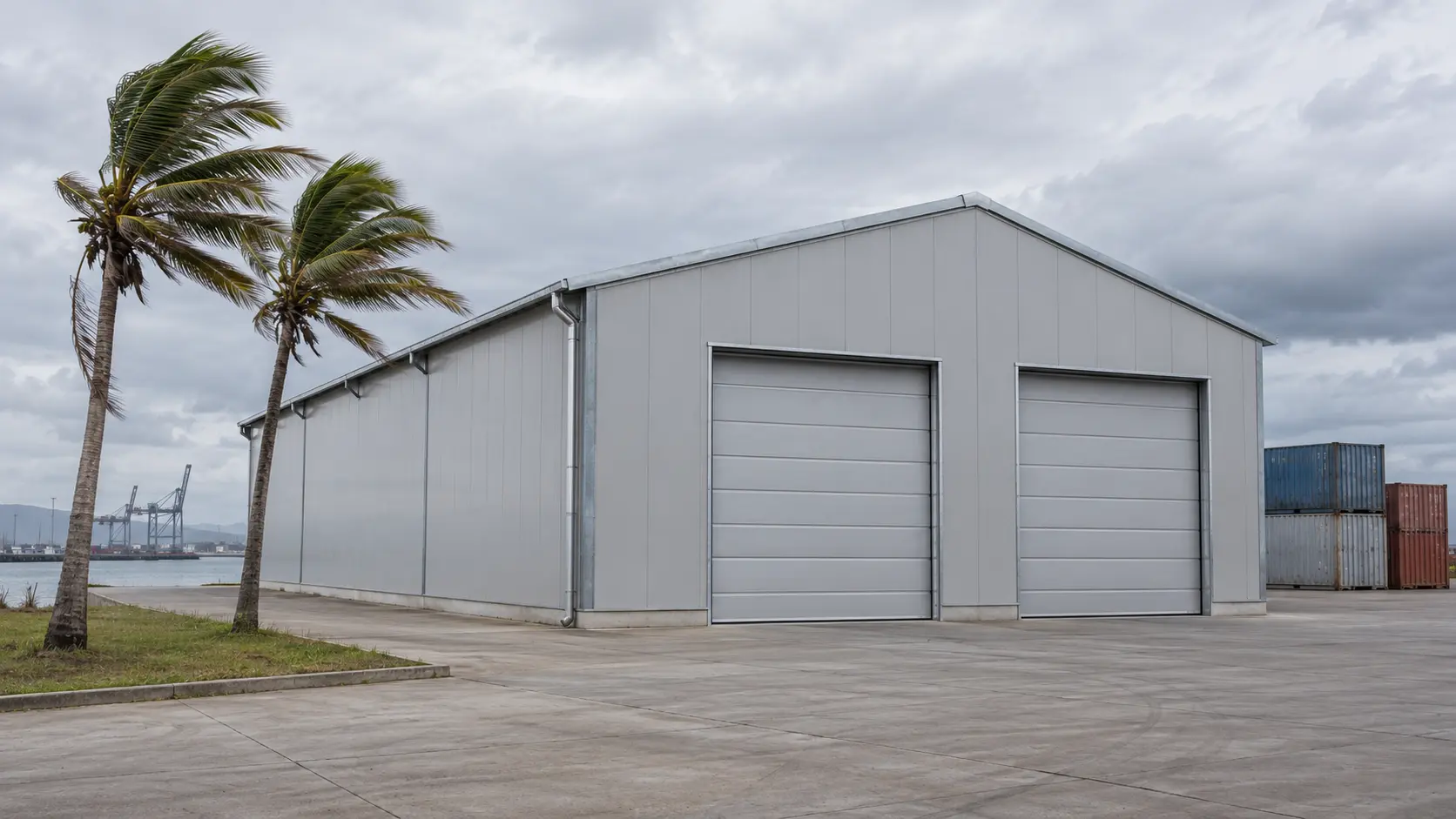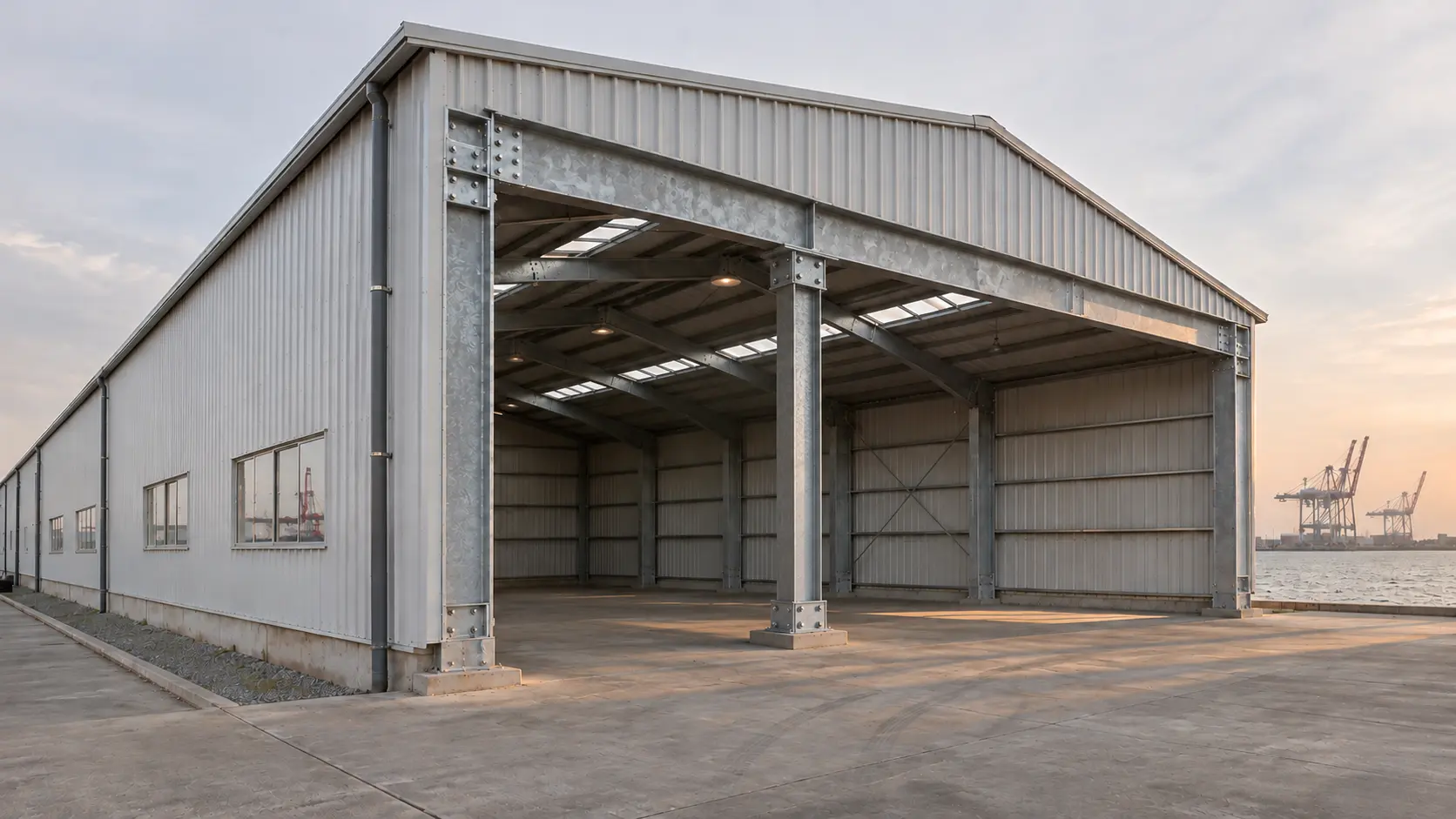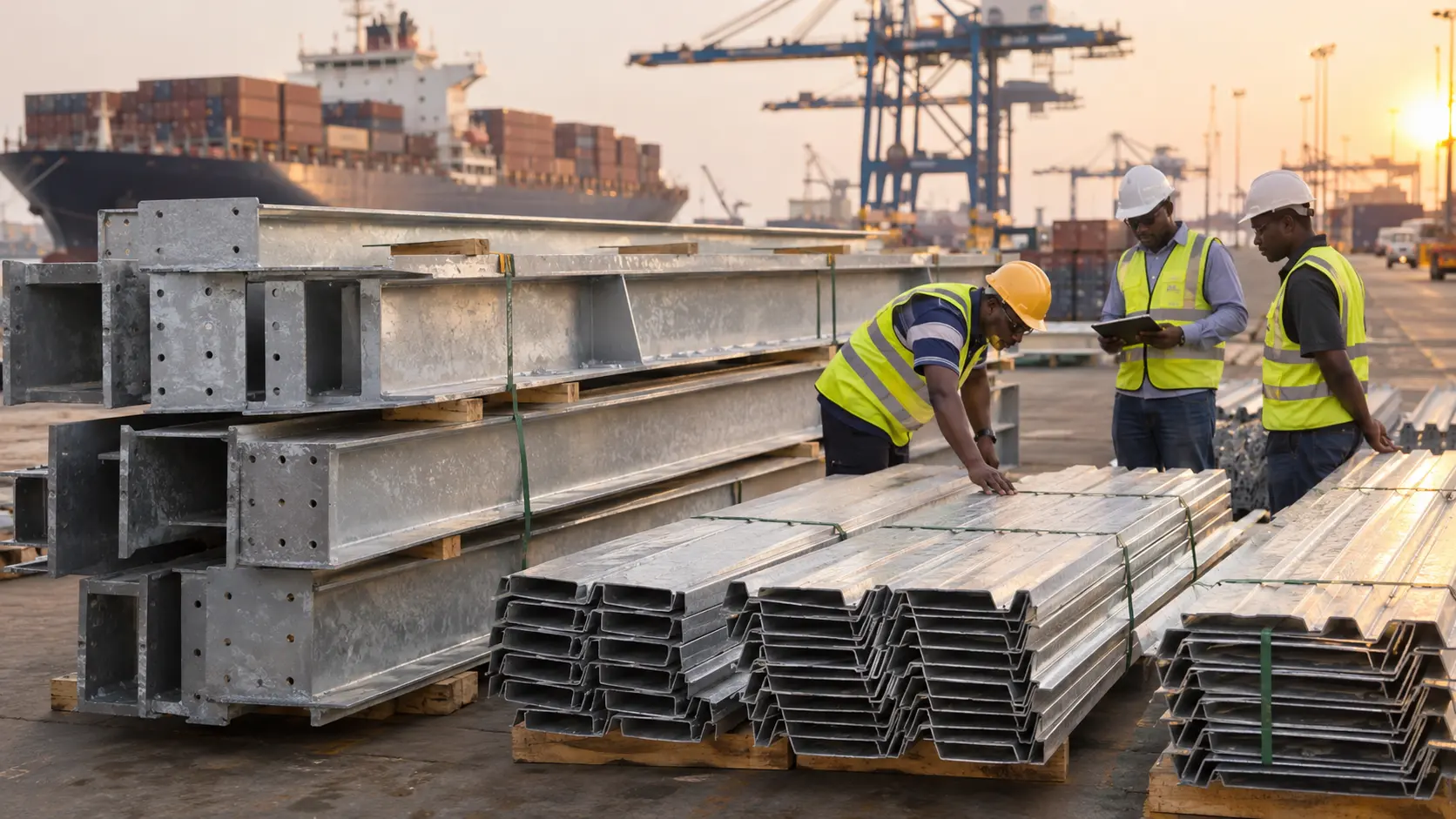
Steel is strong, fast to erect and cost-efficient. Near the sea, it also has a weakness: salt-laden, humid air attacks unprotected steel relentlessly. For developers in coastal industrial zones, port engineers and factory owners, the coating system is one of the most important decisions in the project. A good choice keeps the building sound and maintenance predictable. A poor one can mean visible rust within a few years, repeated repainting and, in the worst cases, structural repairs.
This guide explains corrosion protection steel building owners need in marine conditions. It compares hot-dip galvanizing (HDG) with protective paint systems, explains how ISO 12944 corrosion categories guide the choice, and sets out a practical maintenance routine for humid climates. It is written with buyers in the UAE and Egypt in mind, where heat, humidity and salt often combine.
Why Corrosion Protection Steel Building Projects Matter in Coastal Environments
Steel rusts when moisture and oxygen reach its surface. Chlorides from sea spray speed this up because salt deposits keep surfaces damp and make the corrosion reaction more aggressive. High temperatures accelerate the chemistry, and overnight condensation on cooling steel keeps surfaces wet.
Typical risk factors at coastal and port sites include:
- Salt-laden air. It is strongest near the shoreline but can travel inland on onshore winds.
- High humidity and condensation on roof members, purlins and wall girts.
- Industrial pollutants at ports, chemical plants and processing facilities.
- Hard-to-inspect details such as bolted joints, sharp edges, welds and water traps.
Exposure varies sharply from site to site. A warehouse on a quay faces very different conditions from one several kilometres inland. Classifying the actual environment is therefore always the first step.
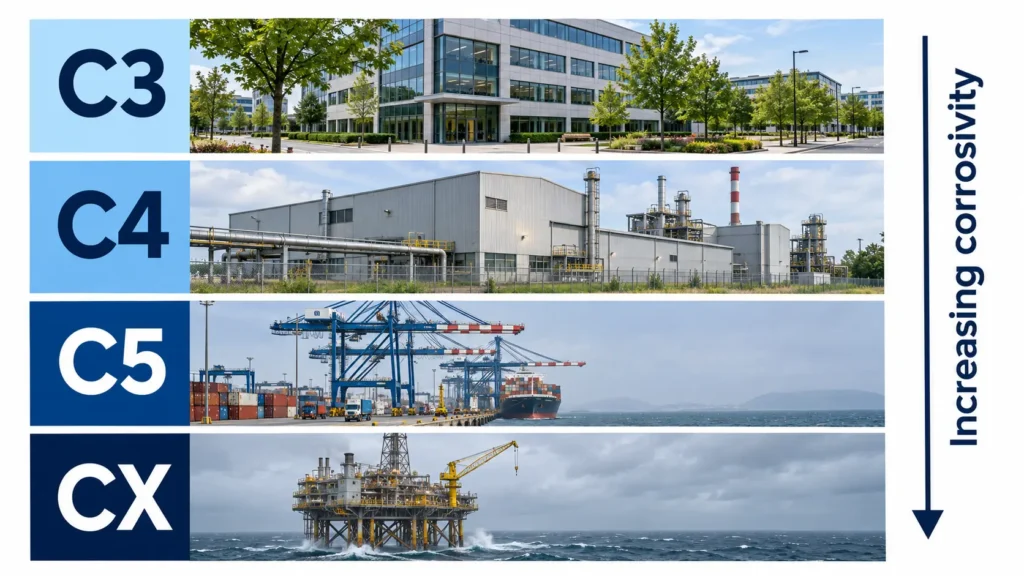
Understanding ISO 12944 Corrosion Categories (C3, C4, C5, CX)
ISO 12944 is the international standard for protecting steel structures with paint systems. It classifies atmospheres by how much steel and zinc corrode during the first year of exposure, and specifiers use those categories to choose a coating system and target durability.
| Category | Typical environment | Coating implication |
|---|---|---|
| C3 (medium) | Urban and light-industrial areas; coastal areas with low salinity | Standard systems often suffice |
| C4 (high) | Industrial areas; coastal zones with moderate salinity | Thicker paint systems or galvanizing |
| C5 (very high) | Heavy industrial and high-salinity coastal or offshore areas | Multilayer paint, galvanizing, or both |
| CX (extreme) | Offshore and extreme humid tropical coastal sites | Specialist heavy-duty systems |
The corrosion rates behind these categories explain why the upgrade matters. In C5, steel loses more than 80 to 200 µm in the first year and zinc loses about 4.2 to 8.4 µm. In CX, steel loss rises to 200 to 700 µm and zinc loss to 8.4 to 25 µm. In C3, zinc loss is only about 0.7 to 2.1 µm. VIOX Electric +2
The standard also notes that in coastal areas in hot, humid zones, thickness losses can exceed the limits of the C5 marine category, so special precautions are needed when selecting paint systems. That applies to many Gulf and Red Sea sites. Ask your supplier to specify against the real site conditions, not just a category label. victaulic
ISO 12944 also defines expected durability ranges (low, medium, high and very high) before first major maintenance. Durability is a planning guide, not a warranty, so confirm the exact range and the current edition of the standard with your coating supplier.
How Hot-Dip Galvanizing Protects Steel
In hot-dip galvanizing, fabricated steel members are cleaned and dipped in molten zinc. The zinc bonds metallurgically to the steel, forming a coating that protects in two ways. It acts as a barrier against moisture and salt, and it protects sacrificially, corroding in preference to the steel if the surface is scratched.
Advantages in marine conditions
- Complete coverage. Edges, corners, hollow sections and internal surfaces are coated, which are the areas paint reaches least reliably.
- Factory-controlled quality. The coating is applied in a workshop, not in humid site conditions.
- Low maintenance. A sound zinc coating needs little attention until it is nearly consumed.
- Mechanical toughness. The coating resists handling damage during transport and erection.
Limitations to plan for
- Size and shape. Members must fit the galvanizing bath, and long or very large assemblies may need splicing.
- Distortion risk. Thin or unsymmetrical sections can warp in the hot bath, so detailing matters.
- Colour. The finish is metallic grey, and a colour or brand finish needs a paint topcoat.
- Design details. Vent and drain holes are needed so zinc can flow and trapped air can escape.
ISO 1461 sets minimum coating thicknesses for batch galvanizing according to steel thickness. Do not confuse this with the zinc weight on pre-galvanized coil used for cold-formed parts. Welldone Steel’s C/Z purlin page lists a hot-dip or pre-galvanized finish with 120 to 275 g/m² of zinc, which is a different process and thickness class from batch galvanizing of fabricated frames.
Protective Painting Systems for Marine Environments
A protective paint system is a multi-coat build, not a single layer. A common marine-grade arrangement is a zinc-rich epoxy primer, an epoxy intermediate coat and a polyurethane topcoat. One published industry example for C5 uses a zinc-rich epoxy primer of 100 to 150 µm, an epoxy intermediate of 100 to 150 µm and a polyurethane topcoat of 80 to 100 µm, for a total dry film thickness of 200 to 250 µm. Treat that as an example only. Your actual system and thickness must follow ISO 12944-5 and the coating manufacturer’s data sheet.
Advantages
- Colour and branding. Full RAL colour choice suits corporate facilities.
- No size limit. Large frames and complex assemblies can be coated in a workshop or on site.
- Repairable. Damaged areas can be touched up, and the system can be refreshed later.
- Flexible performance. Thicker or more advanced systems can be specified for higher categories.
Limitations
- Surface preparation decides performance. Abrasive blasting to Sa 2½ is generally expected in C4 and C5 environments, and poor preparation is the most common cause of early failure.
- Application conditions. High humidity, dew point and hot surfaces can ruin coating quality if not controlled.
- Scheduled maintenance. Paint eventually weathers and needs repair or recoating.
- Weak spots. Edges, welds and bolts need extra attention, usually with stripe coats.
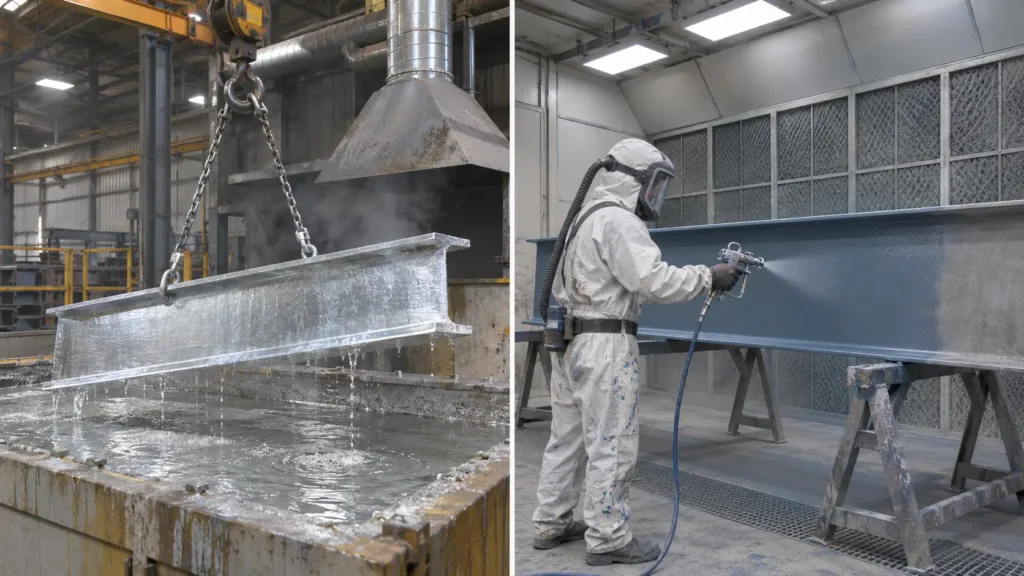
Hot-Dip Galvanizing vs. Protective Paint: Which Is More Cost-Effective?
Neither option wins every time. The answer depends on the corrosion category, the design life, the access for future maintenance and the appearance you need.
| Factor | Hot-dip galvanizing | Multilayer paint |
|---|---|---|
| Upfront cost | Often higher for the full frame | Varies with system and surface preparation |
| Edge and corner coverage | Excellent | Needs careful application |
| Maintenance frequency | Low | Scheduled repainting |
| Colour options | Grey (paint topcoat optional) | Full range |
| Size limits | Bath dimensions | None |
| Best use | Purlins, girts, bolts, hard-to-access parts | Large frames, branded finishes |
HDG tends to be more cost-effective when:
- Future repainting would be costly or disruptive, such as at an operating port or plant.
- The design life is long and the category is C4 or higher.
- The members are repetitive and fit the bath, which is typical for purlins and girts.
Paint tends to make more sense when:
- Members are very large or must be coloured to match a brand.
- The environment is only moderately aggressive and maintenance access is easy.
- Site welding or modification is expected after coating.
Compare options over the building’s whole life, not just the purchase price. Initial cost and long-term cost often point in different directions.
Duplex Systems: Galvanizing Plus Paint for C5 and CX Zones
For the harshest coastal conditions, many specifiers combine both methods. A duplex system applies paint over hot-dip galvanized steel. The paint shields the zinc from salt, and the zinc stops corrosion creeping under the paint film.
Published industry guidance says the time to first maintenance of a duplex system is about 1.5 to 2.3 times the sum of the individual service lives of galvanizing and paint alone. The lower multiplier applies to the harshest conditions: a minimum of 1.5 is intended for the most aggressive environments with high pollution, salt or humidity. In practice, the main benefit is extending the time to first maintenance of the paint by 1.5 to 2.0 times compared with bare steel.
The cost trade-off is real but often favourable over time. In one US example for a C3 environment, a duplex system cost 71% more initially but gave a 45% life-cycle saving compared with paint on black steel. That result is illustrative and depends on local costs, so request a quotation based on your own project.
A duplex system requires correct surface preparation of the zinc and a compatible primer. Specify it as one system, with the galvanizer and paint applicator coordinated.
Protecting the Whole Building Envelope, Not Just the Frame
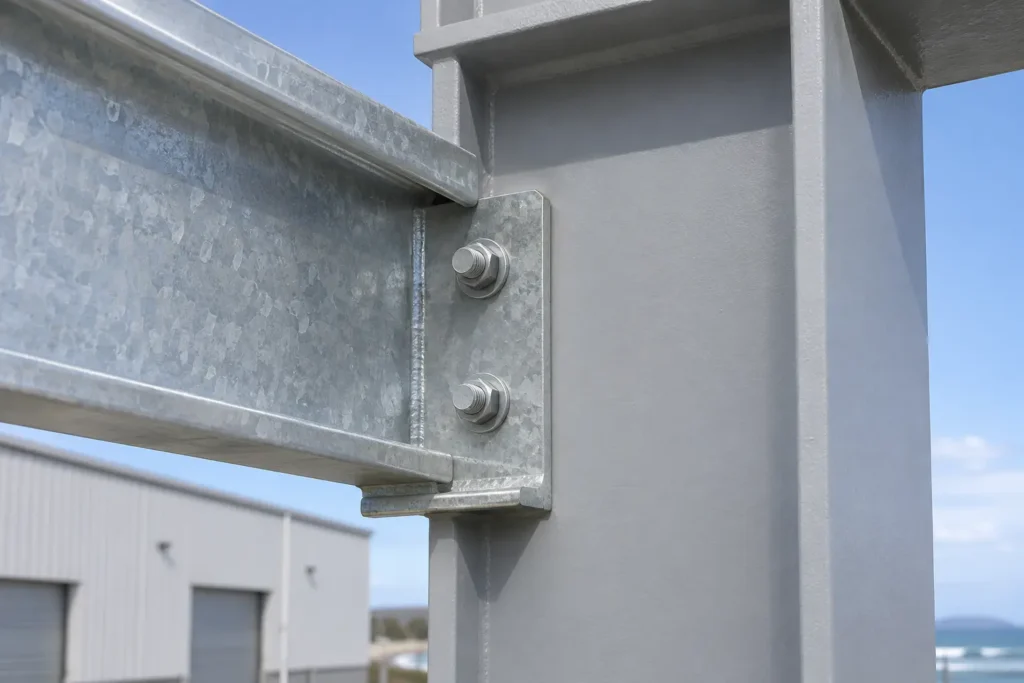
Corrosion rarely starts on the main columns. It usually starts at the details:
- Secondary members. Roof purlins and wall girts are numerous and exposed to condensation, so galvanized C/Z purlins are a sensible choice for coastal sites.
- Cladding. Roof and wall sheets and panels must have a coating suited to the category, and cut edges need sealing. Our guide to insulated sandwich panels for walls and roofs explains why facing coatings and joint detailing matter in humid or coastal sites.
- Fasteners. Use fasteners with corrosion resistance matched to the cladding and avoid mixing metals that create galvanic corrosion.
- Drainage and details. Avoid water traps, add drainage, and design joints so moisture can escape.
For a complete building, our steel warehouse building page lists both painted and hot-dip galvanized surface treatments, and notes galvanized steel for coastal or corrosive environments.
A Maintenance Schedule for Humid and Coastal Climates
Even the best coating performs better with routine care. Confirm exact intervals with your coating manufacturer, but a practical routine looks like this:
- Inspect at least once a year, and after severe storms. Check edges, welds, bolts, roof valleys, gutters and the base of columns.
- Rinse salt deposits from exposed surfaces with fresh water, especially where rain does not wash them naturally.
- Keep drainage clear. Standing water and debris accelerate corrosion.
- Repair damage early. Touch up chips and scratches before rust spreads under the film.
- Record condition. Photos and notes help you plan recoating before failure, not after it.
- Plan major maintenance around the durability range in your coating specification.
Early, small repairs cost far less than late, large ones.
Common Mistakes When Specifying Corrosion Protection
- Choosing by price alone. The cheapest coating can be the most expensive over the building’s life.
- Ignoring the real environment. A generic specification may underestimate a hot, humid coastal site.
- Skipping surface preparation. Any coating on poorly prepared steel will fail early.
- Forgetting the details. Edges, bolts, welds and cut panel edges are where rust begins.
- Mixing incompatible systems. Paint over galvanizing needs the right primer and preparation.
- No maintenance plan. Coatings protect for a period, not forever.
Choosing the Right System for Your Project
Work through these questions with your supplier:
- Which ISO 12944 category applies, and is the site worse than a standard category suggests?
- What design life and time to first maintenance do you need?
- How easy or costly will future maintenance be?
- Do you need colour or branding?
- Will the members fit galvanizing, and is a duplex system warranted?
- How will fasteners, cladding and connections be protected?
If you are planning a coastal factory, warehouse or port facility in the UAE, Egypt or a similar market, you can discuss your project with the Welldone Steel team to review the environment and compare coating options before design is finalised.
Conclusion
Effective corrosion protection for steel buildings in coastal and marine environments starts with understanding the site. ISO 12944 categories help define the risk. Hot-dip galvanizing offers dependable low-maintenance protection. Marine-grade paint offers colour and flexibility. A duplex system combines both for the harshest zones. Whatever you choose, specify the whole building, plan inspections and keep up with maintenance.
If you are building near a coastline, request a customized quotation from Welldone Steel and describe your location, building type and design life. The team can help you compare coating options for your project.