Steel is strong, fast to erect and economical. However, corrosion protection steel building solutions are essential in coastal environments, where salt-laden air creates a persistent threat. A building that performs well for decades inland can show rust blooms, bleeding fasteners and failing coatings within a few years if the protection system does not match its environment.
For developers, plant owners and port engineers, the real question is rarely “should we protect the steel?” It is which system, at what specification, and with what maintenance plan. This guide compares hot-dip galvanizing (HDG) with protective paint systems. It explains how ISO 12944 corrosivity categories guide the choice, and how to keep a coastal steel building rust-free over its service life.
Why Corrosion Protection Steel Building Matters in Coastal Environments
Corrosion needs oxygen, moisture and an electrolyte. Coastal air supplies all three. Airborne chlorides settle on surfaces, attract moisture and speed up the electrochemical reaction. Daily wet-dry cycles and warm temperatures push it further. Industrial ports and chemical plants add sulphur compounds and process fumes.
The damage rarely starts on flat, clean surfaces. It starts at weak points:
- Cut edges, weld zones and bolt holes
- Purlin ends and cleats
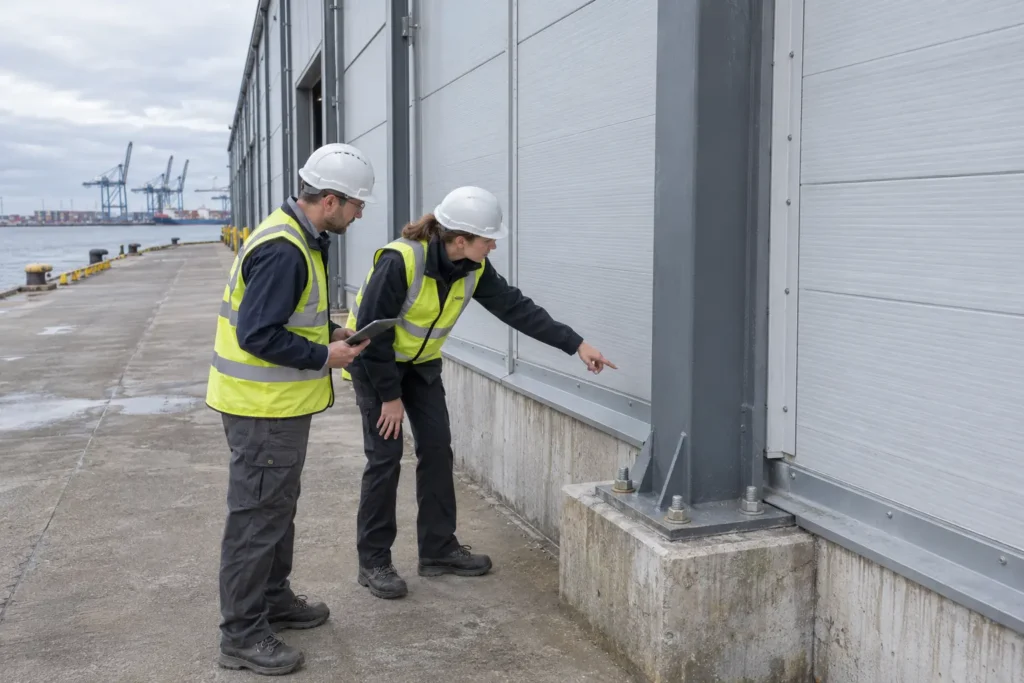
- Column bases and wall bottoms where water pools
- Gutters, flashings and roof laps
- Places where condensation forms, such as the underside of poorly ventilated roofs
A good coastal specification therefore covers the coating system and the design details together.
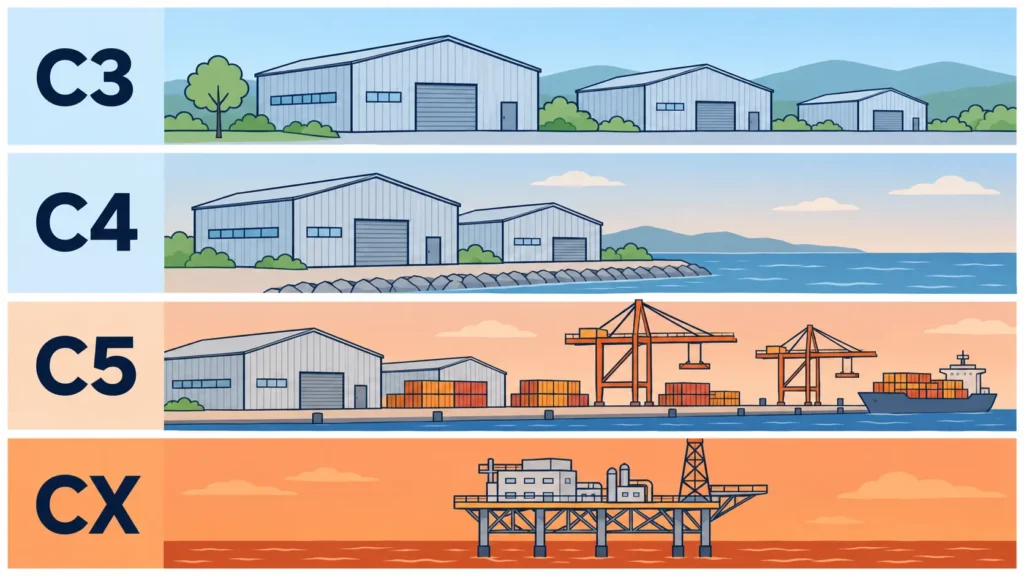
Understanding ISO 12944 Corrosivity Categories (C3, C4, C5, CX)
ISO 12944 classifies atmospheric environments by how fast standard steel and zinc samples lose thickness in their first year of exposure. For building owners it is the common language between designer, coating supplier and fabricator.
| Category | Typical environment (informative) | Steel loss, year 1 | Zinc loss, year 1 |
|---|---|---|---|
| C3 – Medium | Urban/industrial air, low-salinity coastal areas | 25–50 µm | ≈0.7–2.1 µm |
| C4 – High | Industrial areas, coastal areas with moderate salinity | 50–80 µm | >2.1–4.2 µm |
| C5 – Very high | Aggressive industrial areas, high-salinity coast | 80–200 µm | >4.2–8.4 µm |
| CX – Extreme | Offshore and extreme exposure | 200–700 µm | >8.4–25 µm |
The 2018 revision merged the older C5-I and C5-M categories into a single C5 and added CX for offshore conditions. The standard also defines expected coating durability ranges: Low (up to 7 years), Medium (7–15), High (15–25) and Very High (more than 25). These are time-to-first-major-maintenance ranges, not warranties.
Use the table as a starting point, not a final answer. Distance from the sea, prevailing wind, site shelter, local pollution and interior humidity all shift the category. Ask your designer or coating supplier to confirm it for your exact site.
Hot-Dip Galvanizing: How It Works and Where It Excels
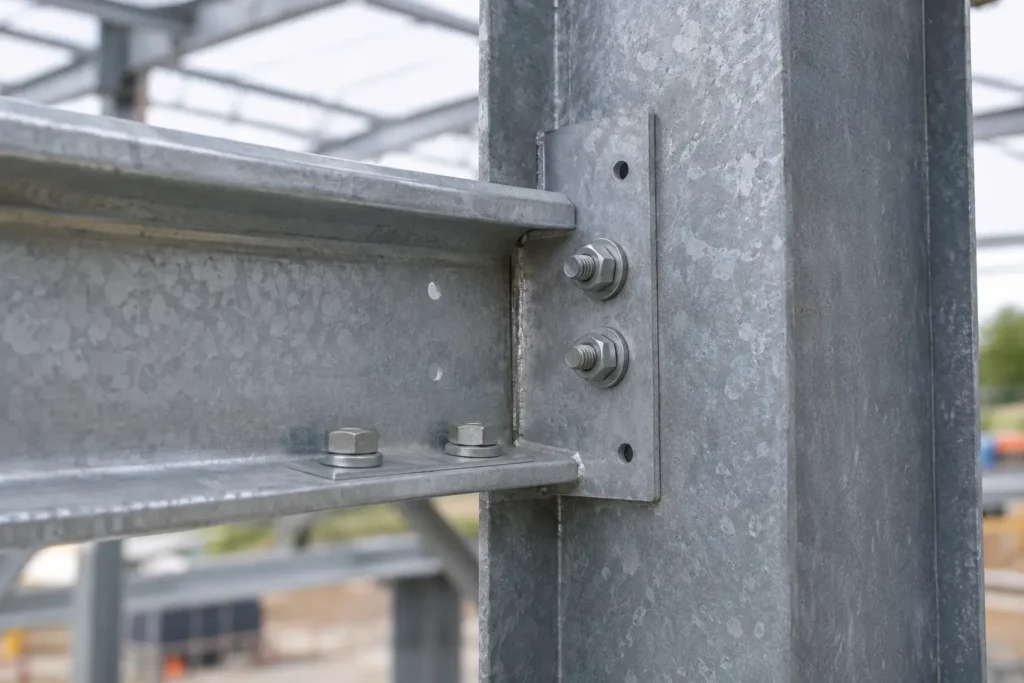
In hot-dip galvanizing, fabricated steel members are cleaned, then dipped in molten zinc at around 450 °C. The zinc bonds metallurgically to the steel. It protects in two ways: as a barrier, and sacrificially, because zinc corrodes in preference to the steel beneath it, even at small scratches and cut edges.
ISO 1461 ties minimum coating thickness to steel thickness:
| Steel thickness | Minimum average coating |
|---|---|
| Over 6 mm | 85 µm |
| 3–6 mm | 70 µm |
| 1.5–3 mm | 55 µm |
| Under 1.5 mm | 45 µm |
Strengths
- Coats edges, corners, hollow interiors and bolt holes that spray application struggles to reach
- Tough and abrasion-resistant, so it handles transport and erection well
- Little or no routine repainting when exposure suits the coating thickness
- Predictable thickness, linked to the steel section
Limitations
- Members must fit in the galvanizing bath, so very long or deep sections may be restricted
- Thin or asymmetric sections can distort in the heat, which needs good detailing
- Colour options are limited unless a paint topcoat is added
- Welding, drilling and cutting must be finished before galvanizing
One distinction matters in specifications. Pre-galvanized (continuous-line) coil carries a much thinner zinc layer than after-fabrication HDG. One manufacturer brochure, for example, lists the standard Z275 grade as roughly 19 µm average. Welldone Steel’s C/Z purlin page lists hot-dip or pre-galvanized finishes with zinc coatings of 120–275 g/m², and notes that zinc weight can be adjusted to climate and local requirements. In a C4 or C5 location, confirm which galvanizing type and weight apply to each component.
Protective Paint Systems: Marine-Grade Coatings Explained
Protective painting uses several layers, each with a job. A typical high-performance system includes:
- Primer, often zinc-rich epoxy, which bonds to the steel and adds galvanic protection
- Intermediate coat, usually a high-build epoxy, which thickens the barrier
- Topcoat, commonly polyurethane, which resists UV and keeps colour and gloss
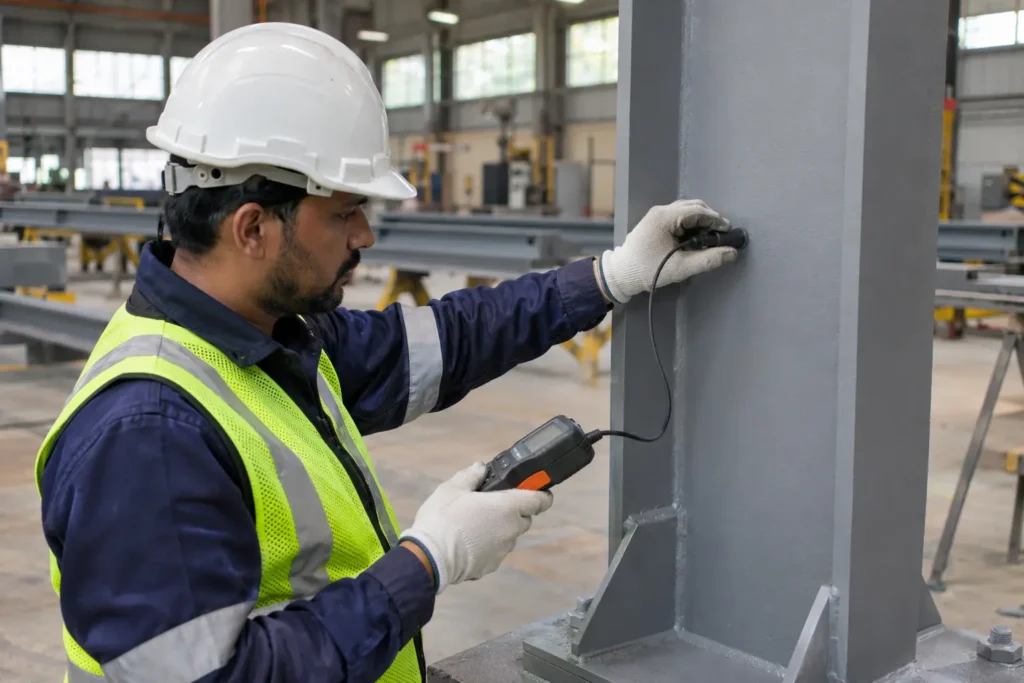
Surface preparation decides most of the outcome. Abrasive blasting to the specified cleanliness grade, correct profile and controlled humidity during application matter more than the brand on the tin. The 2018 edition of ISO 12944 also requires a more thorough preparation grade (P3) for high and very high durability in C4, C5 and CX environments.
Strengths
- Wide colour choice for branding and visual requirements
- Can be applied to very large or awkwardly shaped assemblies
- Local repairs are straightforward with compatible products
- Often lower upfront cost than galvanizing, depending on the system and market
Limitations
- Performance depends heavily on application quality
- Edges, welds and bolts are weak spots unless they get extra coats
- Transport and erection damage must be touched up on site
- Repainting is expected over the building’s life
Hot-Dip Galvanizing vs. Protective Painting: Side-by-Side
| Factor | Hot-dip galvanizing | Multi-coat protective paint |
|---|---|---|
| Initial cost | Often higher for the coating itself | Often lower, depending on system |
| Edge and hole protection | Excellent | Needs extra coats and careful application |
| Damage tolerance | Sacrificial zinc protects small scratches | Damaged areas need prompt repair |
| Colour and appearance | Metallic grey unless topcoated | Wide colour range |
| Routine maintenance | Low | Planned repainting cycles |
| Size limits | Limited by bath size | Few limits |
| Quality sensitivity | Process-controlled, thickness predictable | Highly dependent on site conditions and applicator |
Duplex systems combine both: galvanizing first, then paint. ISO 12944 recognises painting over zinc, and the paint slows zinc consumption while the zinc protects the steel if the paint is damaged. It suits C5 sites, hard-to-maintain members and projects that need both colour and long life.
When Hot-Dip Galvanizing Is More Cost-Effective
Compare life-cycle cost rather than first cost. HDG usually wins when:
- The site is C4 or C5, and the building is expected to run for decades
- Members are hard to reach later, such as high roof steel and crane-bay structures
- Remote ports or sites make repainting logistically expensive
- Fabricated sections are small to medium and fit the bath
Paint may be the better option when:
- Large assemblies exceed bath dimensions
- Colour or branding drives the design
- The environment is nearer C3 and the owner has a maintenance programme
- Components are field-welded or modified after fabrication
For most coastal industrial buildings, the sensible answer is mixed: galvanized secondary members and fasteners, with a paint or duplex system on the primary frame, matched to each element’s exposure.
Don’t Forget Purlins, Fasteners and Cladding
The frame is only one part of the system. A galvanized or painted frame can still fail early if the rest of the envelope is mismatched.
- Purlins and girts: Use galvanized C/Z purlins with an appropriate zinc weight for the site category.
- Fasteners: Choose corrosion-resistant fasteners compatible with the cladding to avoid galvanic problems.
- Cladding and insulation: Facing coatings, edge sealing and condensation control matter as much as U-value. Our guide to insulated sandwich panels for walls and roofs covers panel cores and the humidity and coastal considerations.
- Detailing: Slope surfaces to shed water, avoid water traps, provide drainage and ventilate roof spaces.
Planning a building near the coast? Tell the Welldone Steel team your site location, distance from the sea and building use, and request a coating recommendation with your quotation.
Regional Considerations: Philippines, UAE, Indonesia and Egypt
Local conditions change both the corrosivity category and the maintenance plan, so treat these as starting points rather than design inputs.
- Philippines: A long coastline, warm humid air and typhoon exposure make both corrosion and wind-driven rain relevant. Pay attention to fastener sealing and roof-edge detailing.
- UAE: Hot, humid Gulf coasts combine salt air with high temperatures and, in some areas, salt-bearing ground. Interior condensation and thermal movement affect coatings.
- Indonesia: Tropical humidity across a large island nation means wet conditions for much of the year. Ports and processing sites often sit near C4 or C5 conditions.
- Egypt: Mediterranean and Red Sea sites, port zones and industrial districts can see high salinity and dust. Welldone Steel also publishes Egypt-focused information for local buyers.
For UAE-based reference, Welldone Steel lists a large span steel building project in the United Arab Emirates covering 14,000 m².
Maintenance Schedule for Humid, Coastal Climates
Even the best coating performs better when inspected. A practical outline:
- After erection: Inspect transport and installation damage, and touch up promptly.
- Annually: Walk the building, checking edges, welds, bolt heads, roof laps, gutters and column bases.
- After storms or flooding: Check for debris, water ingress and damaged coatings.
- Regular washing: Rinse accessible surfaces where salt deposits accumulate, using a method suited to the coating.
- Spot repairs: Treat damaged galvanizing with a suitable repair system. ISO 1461 specifies a minimum repair coating thickness of 100 µm.
- Planned repainting: Set an interval based on the system’s durability range and observed condition, not on a fixed calendar.
Keep inspection records. They help you catch small problems early and plan maintenance budgets.
How to Choose: A Practical Selection Guide
- Define the site: distance from the sea, wind direction, port or industrial exposure, and interior humidity.
- Confirm the ISO 12944 category with your designer or coating supplier.
- Set a durability target (for example, 15–25 years to first major maintenance).
- Evaluate each component (frame, purlins, fasteners, cladding), not just the building overall.
- Compare life-cycle cost, including repainting, access equipment and downtime.
- Ask for the specification in writing: coating type, thickness, preparation grade and applicable standard.
Common Mistakes to Avoid
- Choosing a coating without confirming the corrosivity category
- Specifying galvanizing without stating the standard, such as ISO 1461, or the thickness
- Comparing only the initial price
- Ignoring weld, edge and bolt treatment
- Mismatched fasteners and cladding
- Leaving out drainage and ventilation details
- Having no inspection and touch-up plan
Welldone Steel Solutions for Corrosive Environments
Welldone Steel manufactures steel warehouse buildings with surface treatment options of painted or hot-dip galvanized finishes. Its product page lists Q235 and Q355 steel grades and recommends galvanized steel for coastal or corrosive conditions. Each project is engineered to local conditions. For coastal sites, share your location and exposure so the team can match the coating system to your building.
Conclusion
Protecting a steel building near the sea comes down to matching the coating system to the real environment. Establish the ISO 12944 category, compare hot-dip galvanizing and protective painting on life-cycle cost, treat edges, fasteners and purlins as part of the system, and plan inspections from day one. In harsh C4 and C5 conditions, galvanizing or a duplex system often delivers the lowest maintenance burden. In milder zones, a well-applied paint system with a maintenance plan can work.
If you are planning a coastal warehouse, factory or workshop, the Welldone Steel team can review your site conditions and recommend a coating approach. Request a quotation and include your location, building size and exposure so the specification fits your project.